5 Ways to Optimize Application Sourcing Costs in an AI-Enabled Market
Application sourcing —software, support, labor and managed services — presents a prime opportunity to reduce spend and improve value realization.
Achieve a competitive edge through sustainable cost transparency, cost reduction and cost agility across your technology and business operations.


Traditional approaches to cost optimization are still good hygiene, but today remaining competitive requires AI-driven cost transformation. We address three levels of cost optimization, identifying quick-win and deep-potential opportunities and working toward both simultaneously. ISG helps our clients achieve fast, sustainable savings through AI-centered expert advisory, market data and insights, and execution support.
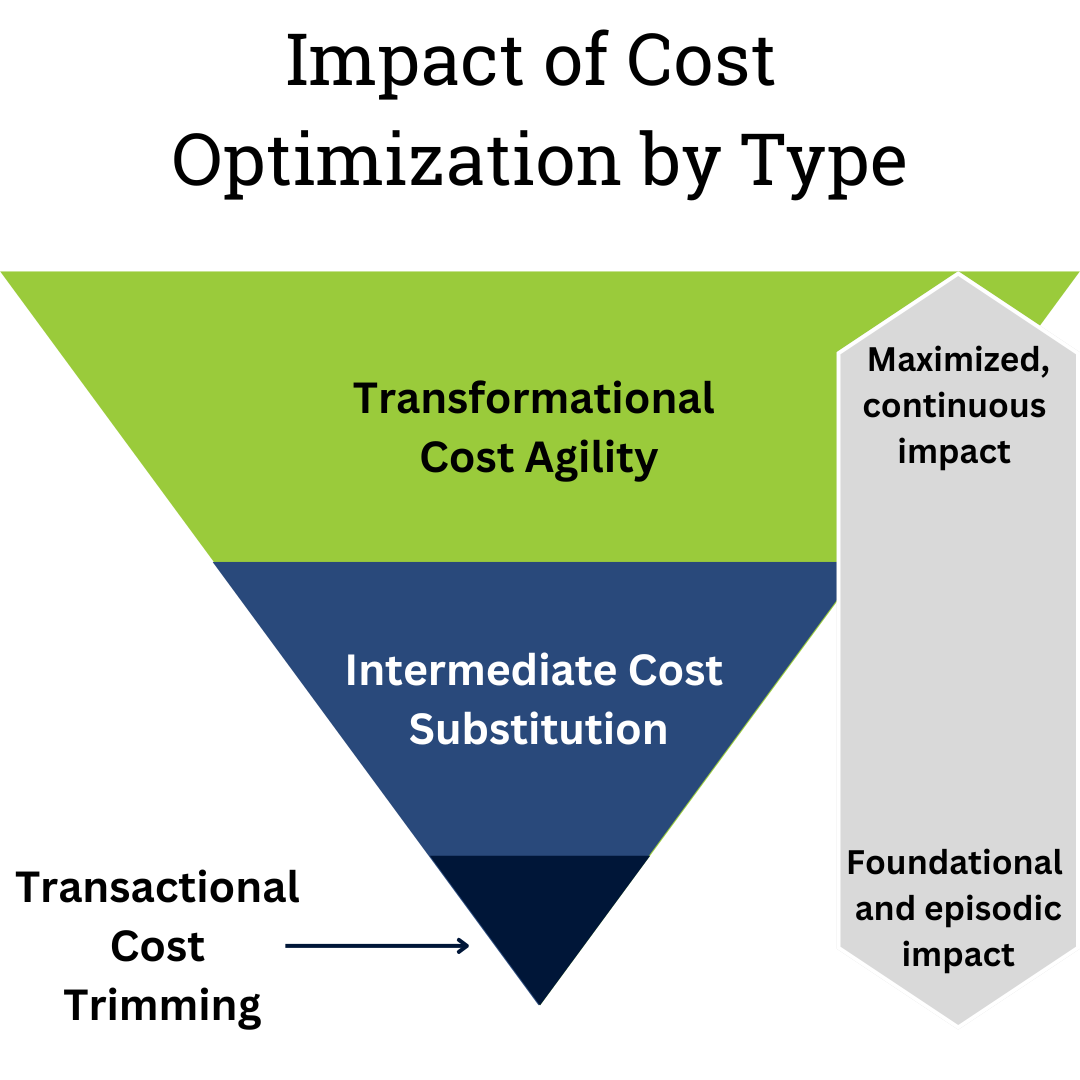
The final method is a cost transformation of your business' operating model for agility, resulting in cost transparency. Using zero-based budgeting to stay goal-aligned, AI to accelerate the business, and change management to empower your people, you can continuously optimize costs to stay competitive.
An intermediate method, cost substitution, involves operating model substitution usually through outsourcing, global capability centers, and/or AI and automation to drive sustainable cost resets.
Think of traditional cost trimming methods as pushing down on a balloon - often, this causes another area to bulge because it's not addressing the big picture. Cost trimming is transactional - good to achieve quick wins, but it should be implemented as part of a holistic cost optimization program.
Get Started Today
We believe that you can't manage what you don't measure. The first step to achieving optimized costs is knowing where you are mis-aligned with the market and your goals.
We perform a rapid, holistic market assessment of your IT and business functions looking for opportunities in four areas by asking:
We build a transformation roadmap prioritizing your cost optimization opportunities, a business case with an operational expenditure (OpEx) view, and a future-state operating model design.
We execute the transformation plan to realize phased savings, leveraging strengths in organizational change management, operating model design, sourcing and market data/research.
How do you know your project costs are reasonable and being controlled appropriately?
We simplify project cost and effort estimation, preventing scope creep with rigorous controls and governance, providing you with:
Saving shouldn’t compromise your growth. That's why ISG aligns cost optimization with your top-line business strategy, ensuring the program enables, and never hinders, your next move. We help you achieve sustainable savings that won't have cost bounce backs by integrating a cost optimization center of excellence into your company DNA. And our results speak for themselves:
Software and Cloud, Network and Telecom, Service Providers
20% TO 30% OF SPECIFIC EXTERNAL SPEND IN SAVINGS
________________________________________________________________________
Contract Governance, Telecom Audit, Software Audit Defense
10% TO 35%* OF APPLICABLE EXTERNAL SPEND IN SAVINGS
*For software audits, we see savings <95% of applicable external spend
________________________________________________________________________
Managed Services Sourcing, GCCs, Automation
20% TO 50% OF OVERALL COST AREAS
________________________________________________________________________
Software Asset Management (SAM), FinOps, Technology Business Management (TBM), Project Estimation and Controls, or Application Rationalization
15% TO 30% OF SPECIFIC COST AREAS
Cost optimization often fails because teams treat symptoms and act at the wrong time. Price cuts alone deliver short-lived savings that bounce back. The winners move at key inflection points, manage total cost (not just price), and lock in gains with live data, shared ownership, clear decision rules and governance at the moments that matter.
Yes, but only in meaningful ways when it’s embedded with finance, operations and technology. Negotiation alone won’t control costs. Procurement should orchestrate demand forecasting, architecture and usage optimization, continuous monitoring and policy controls, so the pricing, discounts, commitments and flexibility in the contract match how you actually use the service and can scale up or down as usage changes.
Begin with a rapid assessment to identify opportunities and quantify the size versus the effort. Then launch quick wins while shaping solutions for larger challenges. Conduct a total cost of ownership (TCO) benchmark and a review of financial processes and controls, operating model, technology use and external spend. The output should be a pragmatic, time-phased roadmap.
Build a “smarter” organization. This means breaking down silos, creating a single source of truth on costs and integrating functions around shared data and decision models. Pair this with strong organizational change management to embed new ways of working. Over time, momentum compounds into a cost-and-performance flywheel.
Benchmark your total costs for key processes. Stand up a cross-functional cost optimization center of excellence with the mandate to drive sustainable savings over the near term, mid-term and long term. Shift the mindset from price cutting to finding lower cost solutions with the benefits of transformation. Build governance to continuously review technology lifecycle decisions. Partner with tech-enabled providers and structure contracts to accelerate savings.
